

Create a chart
Create a new chart
Select + New chart to start a new chart. To build on an existing chart, select ⋮ to the right of the chart > Duplicate. ➀ Toolbar — hover over each tool to see a description. Use the Slider to view or compare time series values.➁ Open in… — download, duplicate, delete, or open the chart in Canvas.➂ Add data — add a time series, or import or create a calculation.➃ Agents — open an AI agent to work with the chart.➄ Sidebar — set up alerting, monitoring, thresholds, or data profiling. Add events and activities.
Use an agent to find and analyze data

To interact with an agent, you need these capabilities.Learn more about Atlas AI.
Add a time series
To add a time series to your chart:Add a calculation
To add a calculation: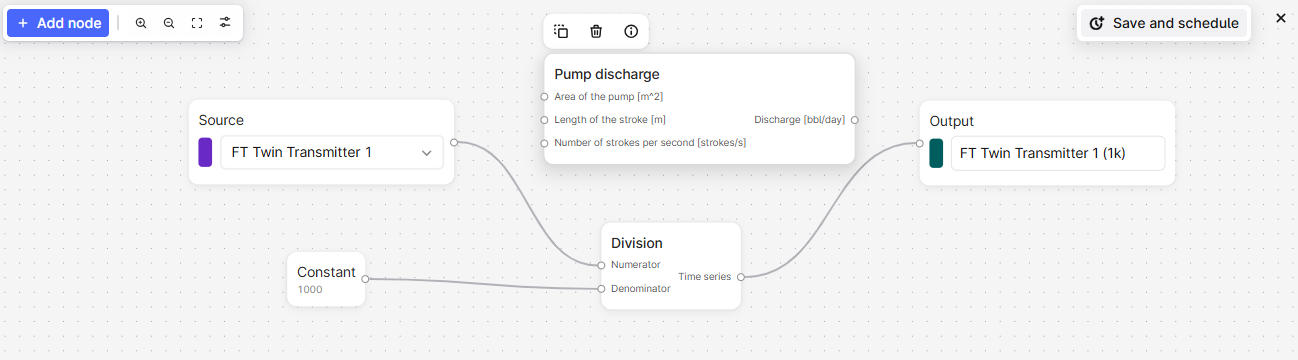
Add constants or functions
Right-click the panel to add constants or functions to the calculation. Select to view the function details or hover over the parameters for more information.
Schedule a calculation
Schedule a calculation and save the result as a time series. You can also monitor the calculation.Save and schedule
Add a calculation and select Save and Schedule.
Specify credentials
Specify the sign-in credentials for the schedule, and click Next. If you don’t know the credentials, contact your CDF admin.
Trend data
To stack, overlay, and compare trends for time series, click+drag or hover+scroll to adjust and move each diagram axis. Use the Slider on the toolbar to view or compare time series values at a specific time.View and assess data quality
A chart line is shaded if the data quality of a time series is Uncertain and has a gap if the quality is Bad. Use data profiling to assess the quality of a time series and whether it fits your purpose. Data profiling uses the Industrial Data Science Library (InDSL) to define gaps if the time deltas deviate by more than 1.5 times the interquartile range.Open Data profiling
In the chart, select Data profiling. Select the time series you want to assess in the Source dropdown list.
Set thresholds for historical data
To set thresholds for historical data:Add events
You can add events, such as a faulty shutdown, to help analyze time series. To add events to a chart:Add activities
Activities in Cognite Data Fusion (CDF) represent tasks, events, or operations that happen over a period of time in your industrial environment. They provide a structured way to track work, maintenance, inspections, and other time-based activities, connecting planned and executed work with your physical assets and operational data. Turn on Activity to visualize and contextualize time series data with these operational events in your chart. Activities appear as vertical bars in the chart, providing visual reference to help you correlate time series behavior with relevant operational activities such as maintenance work, inspections, or production events.Prerequisites
Before you add activities to a chart, ensure that:- The relevant data is modeled as activities or extended activities in your CDF project.
- You have time series
readaccess rights to view Charts and the relevant data.
Add time series
Select + Add data > Add time series. Search and select the time series you want to visualize.
Select activities
In the Category dropdown, select Activity, and then select the activities you want to visualize.
Once selected, the Activity layer will turn on automatically.
The Asset filter applies automatically based on the time series the assets belong to in the chart. You can clear or add filters based on your preferences.
View activity details
Click an activity bar to view details such as start and end times, a description, and the asset the activity is tied to. Click View details to see full information about the activity.
Monitor time series
Time series monitoring jobs send emails for any breaches to the thresholds you set. If there are several breaches within the minimum duration period, you’ll only receive one email for the period. We recommend that you set a minimum duration of 5 minutes to limit the number of email alerts you receive. The minimum expected data point frequency is 1 minute. If the data points have a lower frequency, alerts may not trigger as expected.Create monitoring jobs
Optional. Configure advanced options
Open Advanced options and specify the sign-in credentials for the monitoring job.