

- Create a pipeline to rerun matching models on data sets to improve the results based on confirmed matches over time. If the data set receives new data, you can rerun the pipeline to find additional matches.
- Run a quick match for one-time matching of individual resources, or groups of resources, to assets. The matching model isn’t stored, and you can’t reuse it or improve it over time.
- Match the nodes in a 3D model to assets.
Prerequisites
You need these capabilities to match entities.Step 1: Select the matching process
1
Navigate to entity matching
Navigate to Data fusion > Contextualize > Entity matching.
2
Choose matching option
Select:
- Quick match for one-time matching processes.
- Create pipeline to create an entity matching pipeline that you can rerun and add matches and rules.
- Match 3D models to match 3D nodes to assets.
Step 2: Select entities and assets to match
1
Select source entities
Under Select entities, select the resource types you want to match from. Then select one or more data sets if you are creating a pipeline or individual entities if you are running a quick match.
2
Select target assets
Under Select assets, select assets if you are running a quick match or one or more data sets if you are creating a pipeline.
Step 3: Set up the matching model and generate suggested matches
1
Select the fields for matching entities
By default, the model uses the similarity between the
name fields when it searches for matches. You can select different fields or add more fields using the dropdown menus and selecting Add fields.Make sure you only select similar fields to help the model find correct matches.
2
Train the matching model
By default, an unsupervised model is used to generate suggested matches. If you manually confirm one or more matches, these are used to improve the model’s match suggestions for pipelines.However, the model can also use matches already in CDF to learn. Select the checkbox Use matched resources as training data to allow the model to train on existing matches in CDF.
3
Select the similarity scoring model
- Select Simple to calculate a similarity score based on identical letter or digit sequences, hereafter referred to as tokens, for each pair of fields defined above. This is the fastest option.
- Select Insensitive, which is similar to simple, but ignores lowercase/uppercase differences.
- Select Bigram, which is similar to simple, but adds similarity score based on bigrams of the tokens (two adjacent tokens). For instance, would AA-11-BB be considered more similar to AA-11-CC than AA-00-BB, while Simple would see them as equally similar.
- Select Frequency weighted bigram, which is similar to Bigram but gives higher weights to less commonly occurring tokens.
- Select Bigram extra tokenizers, which is similar to bigram, but the model learns that leading zeros, spaces, and lowercase/uppercase should be ignored in matching.
- Select Bigram combo, which calculates all of the above options, relying on the machine learning model to determine the appropriate features to use. Hence, this is a good choice if there already exists some matches the model can train on (see option below). This is the slowest option.
4
Optional. Configure rule generation
Select Generate rules if you want the model to generate regular expression rules. These rules can be used to demonstrate similarities between matches and to group matches based on patterns. In the next step, you can confirm a rule, and it will be saved with the pipeline. If new data is added to the pipeline data set and it complies with the rule, the data is automatically matched the next time the pipeline is run. Clear this option if you don’t want the rules to be generated.
5
Run the pipeline
Select Run pipeline to train the matching model on the selected data and to generate suggested matches.
Step 4: Validate suggested matches and update CDF
For pipelines, the entity matching model suggests matches in this order:- Confirmed matches - for pipeline: already confirmed matched entity and asset.
- Confirmed patterns - matches created by one of the already confirmed patterns.
- Predictions from the entity matching model.
1
Filter entities by type
Use the Type dropdown list to select the entities you want to work with:
- All: Show all the entities you have selected for matching.
- Matched: Show entities that have already been matched to an asset. Select this option to change the existing matching for entities.
- Unmatched entities: Show entities that haven’t yet been matched to an asset. Select this option to validate the suggestions and match individual entities or groups of entities to assets.
- Different recommendation: Show entities that have already been matched to an asset but where the model recommends a new match. Select this option to change the existing matching for entities.
2
Optional. Group by pattern
Select Group by pattern to match individual entities that fit the same pattern.
3
Confirm matches
For each entity (or group of entities), you can see the suggested asset matching and search for an asset to match the entity. Select the checkmark to confirm the matching and move the entity to the draft matches section.
4
Review draft matches
Review all the draft matches, and move matches out of the draft matches, if necessary.
5
Save the pipeline (for pipelines only)
If you are creating a pipeline, select Save this pipeline to use this matching model when new data is ingested into the selected data sets.
6
Save to CDF
Select Save to CDF to update CDF with the matches.
Step 5: Rerun a matching model in existing pipelines
If a data set receives new data, you can select Rerun pipeline on the overview page to find additional matches. To adjust the matching model, select Open on the More options button.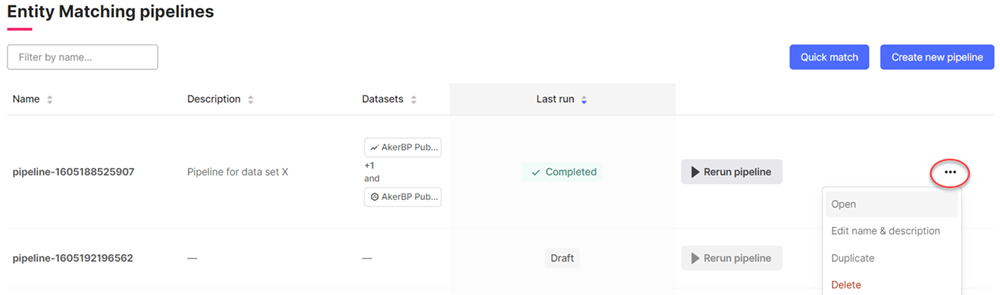
Step 6: Match the nodes in a 3D model to an asset
Contextualize your 3D models so you can see them related to the asset. You can also see the models in the Cognite apps,such as InField and Maintain.Loading the 3D model can take time.
1
Select 3D model revision
Select 3D model revision. The revision number is the version of the model. All the available 3D models in your project are listed.
2
Select assets to match
Select the asset you want to match to the 3D model. You can either group assets by data sets or by root asset.Select Next.
3
Configure matching fields
Select the fields for matching 3D nodes to assets. The model uses the similarity between the Add fields.
4
Choose model type
Select the model type:
- PDMS - improves response time by filtering out nodes that don’t need to be mapped to assets based on keywords in the name.
- Unfiltered - all nodes in the 3D model are used to match assets.
5
Review mapping results
Select Next to see the asset mapping results. The asset mapping result states how many nodes have been contextualized.Select a node in the 3D model to see its contextualizations and use Confidence threshold to see different results.
6
Save matches
Select Save matches to CDF to approve the result.