> ## Documentation Index
> Fetch the complete documentation index at: https://docs.cognite.com/llms.txt
> Use this file to discover all available pages before exploring further.
# Migrating assets
> Step-by-step guide to migrate assets from an asset-centric to a data modeling-based Cognite Data Fusion (CDF) project.
The migration plugin is an experimental feature. Updates to the Cognite Toolkit are likely to introduce changes to the described commands and processes.
This guide walks data engineers through migrating assets from an asset-centric Cognite Data Fusion (CDF) project to data modeling instances and recording lineage in the `CogniteMigration` data model.
## Prerequisites
Before migrating assets, complete the following:
1. [Creating a data model and mappings](/cdf/deploy/cdf_toolkit/guides/plugins/migration_plugin/data_model_migration)
2. [Deploying the CogniteMigration data model](/cdf/deploy/cdf_toolkit/guides/plugins/migration_plugin/prepare)
3. [Migrating data sets](/cdf/deploy/cdf_toolkit/guides/plugins/migration_plugin/datasets)
4. [Migrating source systems](/cdf/deploy/cdf_toolkit/guides/plugins/migration_plugin/source_systems)
## Required capabilities
| Capability type | Action | Scope | Description |
| -------------------- | -------------------------- | ---------------------------- | ---------------------------------------------- |
| Assets | `assets:read` | The selected asset data sets | From data set where you read the source assets |
| Data model instances | `datamodelinstances:write` | The selected instance space | To space where you create the asset nodes |
| Data model instances | `datamodelinstances:write` | cognite\_migration | To create the lineage nodes |
## Migrating assets
Select assets by data set or by CSV file, then run `cdf migrate assets` twice: the first run creates assets and lineage; the second run establishes parent-child relationships.
**You currently need to run this command twice.** The first run creates the assets and their lineage. The second run establishes the parent-child relationships between the assets.
Use [data set selection](#data-set-selection) if all assets go to the same view, mapping, and instance space. Use [CSV file selection](#csv-file-selection) if you need different views, such as the root asset and wind turbines in the [Kelmarsh example](/cdf/deploy/cdf_toolkit/guides/plugins/migration_plugin/example).
Run the command in interactive mode, or pass the options as arguments. See `cdf migrate assets --help`.
```bash theme={"languages":{"custom":["/_languages/kuiper.json","../_languages/kuiper.json"]}}
cdf migrate assets
```
Run the command a second time so parent-child relationships are created after the assets exist.
Confirm that lineage nodes exist in the `InstanceSource` view. See [Verify the migration](#verify-the-migration).
## Data set selection
To migrate all assets in a data set, run the command in interactive mode:
```bash theme={"languages":{"custom":["/_languages/kuiper.json","../_languages/kuiper.json"]}}
cdf migrate assets
```
The command prompts you to select the source data set, resource view mapping, target instance space, and other options. You can also pass all options as command-line arguments. See `cdf migrate assets --help` for details.
The disadvantage of data set selection is that all assets must use the same resource view mapping, target view, and instance space. In the
[Kelmarsh example](/cdf/deploy/cdf_toolkit/guides/plugins/migration_plugin/example), to migrate the root asset to a `KelmarshAsset` view and wind turbine assets to a `WindTurbine` view, use [CSV file selection](#csv-file-selection).
## CSV file selection
To migrate assets using a CSV file, run:
```bash theme={"languages":{"custom":["/_languages/kuiper.json","../_languages/kuiper.json"]}}
cdf migrate assets --mapping-file
```
Replace `` with a path relative to your Cognite Toolkit project root.
This CSV file migrates the Kelmarsh wind farm assets:
```csv title="migration.Assets.csv" wrap theme={"languages":{"custom":["/_languages/kuiper.json","../_languages/kuiper.json"]}}
space,externalId,id,ingestionMapping,consumerViewSpace,consumerViewExternalId,consumerViewVersion
source_data,SEN 93420,2396603511069256,wind_turbine_asset_mapping,sp_schema,WindTurbine,v1
source_data,SEN 93425,3840956528416998,wind_turbine_asset_mapping,sp_schema,WindTurbine,v1
source_data,SEN 93424,5718533083684190,wind_turbine_asset_mapping,sp_schema,WindTurbine,v1
source_data,SEN 93422,6337175473438622,wind_turbine_asset_mapping,sp_schema,WindTurbine,v1
source_data,SEN 93423,7691815129534666,wind_turbine_asset_mapping,sp_schema,WindTurbine,v1
source_data,SEN 93421,8088410340821453,wind_turbine_asset_mapping,sp_schema,WindTurbine,v1
source_data,Kelmarsh,8997492773869554,cdf_asset_mapping,sp_schema,KelmarshAsset,v1
```
Required columns:
* `space`: The target instance space where the asset will be created.
* `externalId`: The external ID of the resulting asset.
* `id`: The integer **internal ID** of the source asset to migrate.
Optional columns:
* `ingestionMapping`: The resource view mapping to use. If omitted, the default mapping for assets is used (typically the CogniteAsset view in the [CogniteCore model](/cdf/dm/dm_reference/dm_core_data_model)). The Cognite Toolkit reads mappings from the `ResourceViewMapping` view in the `CogniteMigration` data model. Deploy custom mappings with `cdf build` and `cdf deploy` using the [Resource view mapping](/cdf/deploy/cdf_toolkit/references/resource_library#resource-view-mapping) resource type.
* `consumerViewSpace`, `consumerViewExternalId`, `consumerViewVersion`: The preferred consumer view for the asset. Canvas and Charts use this setting when they display the asset.
In the example above, wind turbine assets use the `wind_turbine_asset_mapping` mapping and `WindTurbine` consumer view. The root asset `Kelmarsh` uses the default `cdf_asset_mapping` mapping and `KelmarshAsset` consumer view.
## Verify the migration
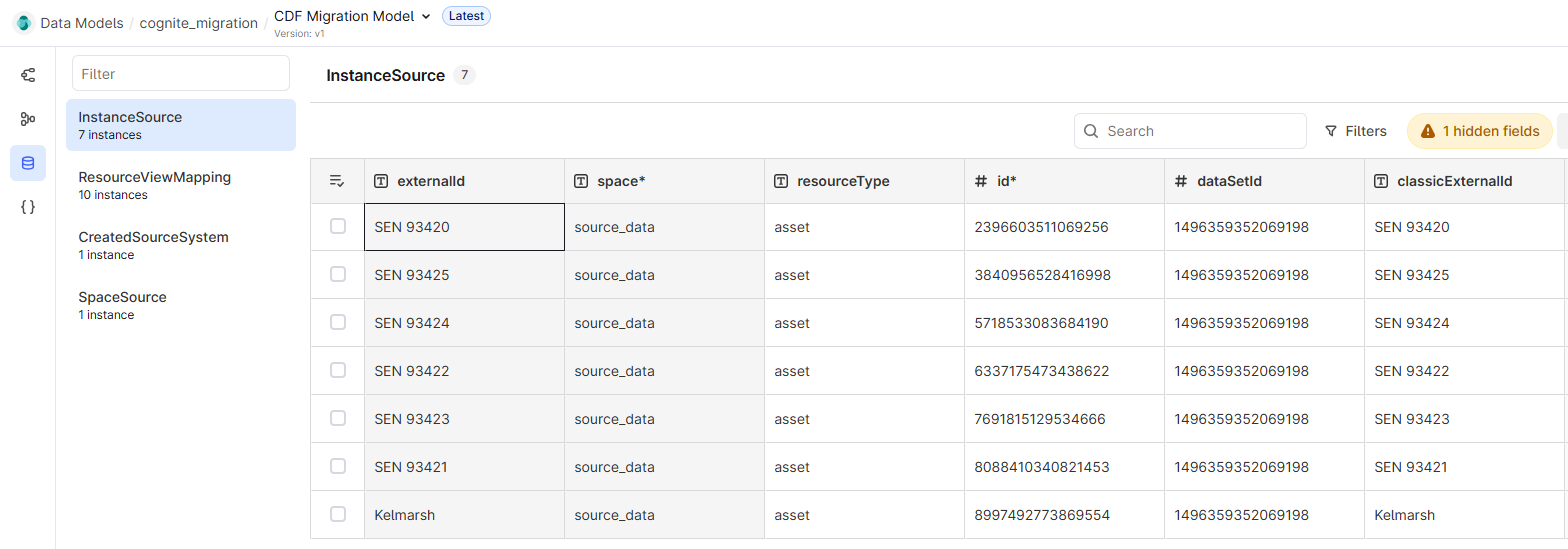
After a successful run, the Cognite Toolkit stores lineage for migrated assets in the `InstanceSource` view in the `CogniteMigration` data model.
In the Kelmarsh example, lineage nodes for the wind turbine assets look like this:
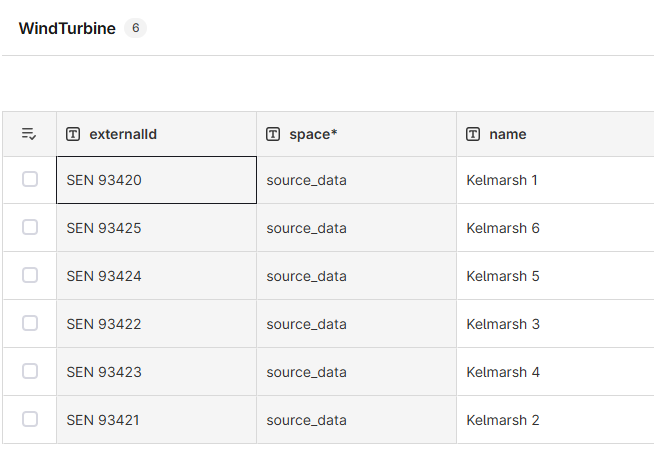
 The lineage nodes are the same instances as the created `WindTurbine` assets:
 ## What `cdf migrate assets` does
When you run `cdf migrate assets`, the migration plugin performs the following steps on batches of assets:
The Cognite Toolkit reads assets from the asset-centric `/assets/byids` or `/assets/list` endpoints, depending on the selection method.
The Cognite Toolkit looks up the mapping and converts each asset to an instance node. Mappings are defined
by `externalId` in the `ResourceViewMapping` view in the `CogniteMigration` data model. The mapping for each asset comes from the `ingestionMapping` column in the CSV file or from the `--ingestion-mapping`
CLI argument. If no mapping is specified, the default mapping is used.
The Cognite Toolkit writes the created instance nodes to CDF using the `/models/instances` endpoint.
While writing instances, the Cognite Toolkit creates lineage nodes in the `InstanceSource` view in the `CogniteMigration` data model
to record the lineage from source assets to the created instance nodes.
## Further reading
* [Migrating events](/cdf/deploy/cdf_toolkit/guides/plugins/migration_plugin/events)
* [Migrating files and time series](/cdf/deploy/cdf_toolkit/guides/plugins/migration_plugin/files_timeseries)
* [Kelmarsh example](/cdf/deploy/cdf_toolkit/guides/plugins/migration_plugin/example)
* [Migration overview](/cdf/deploy/cdf_toolkit/guides/plugins/migration_plugin/steps)
## What `cdf migrate assets` does
When you run `cdf migrate assets`, the migration plugin performs the following steps on batches of assets:
The Cognite Toolkit reads assets from the asset-centric `/assets/byids` or `/assets/list` endpoints, depending on the selection method.
The Cognite Toolkit looks up the mapping and converts each asset to an instance node. Mappings are defined
by `externalId` in the `ResourceViewMapping` view in the `CogniteMigration` data model. The mapping for each asset comes from the `ingestionMapping` column in the CSV file or from the `--ingestion-mapping`
CLI argument. If no mapping is specified, the default mapping is used.
The Cognite Toolkit writes the created instance nodes to CDF using the `/models/instances` endpoint.
While writing instances, the Cognite Toolkit creates lineage nodes in the `InstanceSource` view in the `CogniteMigration` data model
to record the lineage from source assets to the created instance nodes.
## Further reading
* [Migrating events](/cdf/deploy/cdf_toolkit/guides/plugins/migration_plugin/events)
* [Migrating files and time series](/cdf/deploy/cdf_toolkit/guides/plugins/migration_plugin/files_timeseries)
* [Kelmarsh example](/cdf/deploy/cdf_toolkit/guides/plugins/migration_plugin/example)
* [Migration overview](/cdf/deploy/cdf_toolkit/guides/plugins/migration_plugin/steps)